
Read Tattnall County Property Tax Records
Two offices produce Tattnall County's property tax paperwork. The Board of Tax Assessors sets parcel values, maintains the maps, reviews returns, and decides exemptions. The Tax Commissioner bills and collects the tax. A complete read pairs the parcel assessment with the bill and payment record from the same tax year.
| Tax field | Meaning | Keeper |
|---|---|---|
| Fair-market value | January 1 estimate of full value | Tax Assessor |
| Assessed value | Generally 40 percent of fair-market value in Georgia | Tax Assessor |
| Land / improvements | Components supporting the total | Tax Assessor |
| Exemptions | Approved relief or current-use treatment | Tax Assessor |
| Bill / payment status | Amount billed, paid, due, penalty, or interest when shown | Tax Commissioner |
A deed's stated consideration is another figure. It records what a buyer and seller put in writing, not what the assessor concludes about market value. Tag every number with its tax year and source. That habit keeps a digest value, a deed amount, a current bill, and an asking price from being read as one and the same.
Match the Office to the Tattnall Tax Question
Tattnall County splits the work. The Board of Tax Assessors at PO Box 1010 in Reidsville, 912-557-4010, answers assessment, mapping, return, exemption, and appeal questions. The Tax Commissioner, Laura F. Ulin, PO Box 920, 912-557-6736, handles bills, collections, receipts, penalties, interest, and mobile-home, timber, and public-utility tax administration.
Value disputes go through the assessor's appeal process. Balance and payment questions go to the collection office. The two records connect, but one office cannot stand in for the other's decision.
Inspect the Tattnall qPublic Assessment
qPublic's official search page opens with a consent step. Accepting the disclaimer leads to Schneider. The menu offers Search Records, Estimate Taxes, Exemptions, Forms, and General Info. Search by address, owner, or parcel number where offered. A parcel card can list the owner of record, situs and mailing addresses, legal description, land and improvement values, and totals. It can also list assessed value, tax year, exemptions, sales, and map references.
qPublic calls its values the most current published digest information. Maps and ownership may still be in process. A recent sale, permit, return, or appeal can precede an update. Read the card as reliable for its stated cycle. Do not treat it as a live guarantee of title or condition.
The assessor's general-information page lays out the Georgia valuation framework behind any Tattnall tax card.
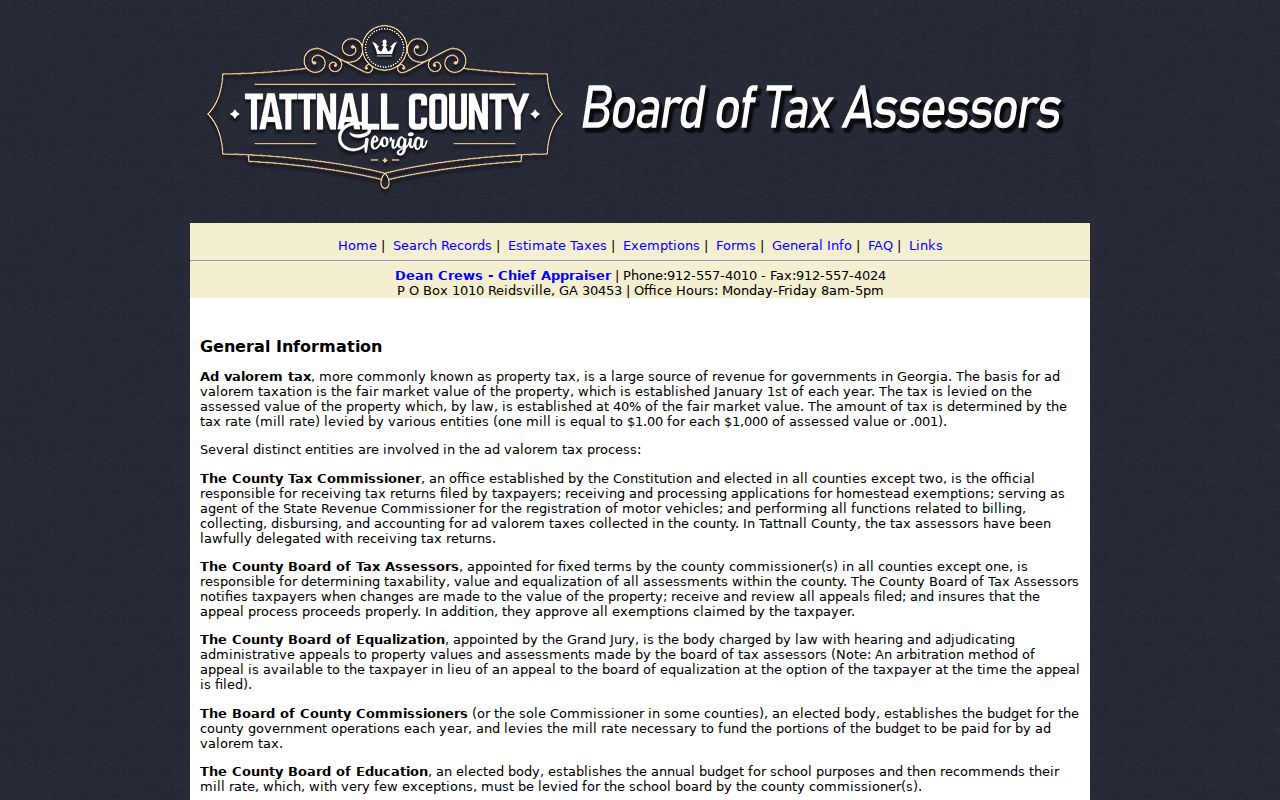
qPublic's official Tattnall landing page sets the scene. The parcel card and Tax Commissioner record then supply the parcel-specific value and bill. That assessor context comes first.

The qPublic landing page marks the official county route. Its warnings matter, but the parcel-specific tax fields appear only after selecting the correct record.
Note: The official search gateway is confirmed; the live Tattnall field labels and year range remain unverified.
Trace a Tattnall County Tax Bill
The county's official payment link redirects to GovernmentWindow. Its landing page shows a Property Taxes button and contact information. Confirm the covered years and any fee during checkout. Fix the parcel identity and year in qPublic before entering the payment route.
- Copy the qPublic APN, owner, situs, assessed value, exemptions, and tax year.
- Choose Property Taxes at the county-linked GovernmentWindow service.
- Match the bill to the same parcel and year; check amount, balance, and payment status.
- Call the Tax Commissioner when an older bill, receipt, penalty, or delinquency detail is unavailable.
- Check the Clerk of Superior Court for recorded tax liens or sale instruments.
- Assessed value
- The taxable base generally set at 40 percent of fair-market value.
- Mill rate / levy
- Dollars of tax per $1,000 of assessed value.
- Homestead exemption
- Approved relief associated with a qualifying home.
- Tax lien
- A claim arising from unpaid tax, checked in the recorded-instrument system.
Use Tattnall’s January 1–April 1 Calendar
Georgia values property as of January 1. Tattnall publishes January 1 through April 1 for property-tax returns, and homestead applications are due April 1 for the current year. A new return may follow acquisition, improvements, or another change, and a taxpayer may return a different value to preserve appeal rights.
The assessor forms page links homestead and agricultural current-use applications. Confirm the current form, evidence, and covenant consequences with the office. A current-use covenant changes tax treatment but does not establish ownership or boundary.
Read Exemptions and Agricultural Covenants by Year
The exemption page covers homestead and current-use assessment. County material also summarizes disabled-veteran and surviving-spouse relief. Verify current eligibility and amounts rather than trusting an older saved form. Compare exemption, acreage, and class year by year. Tattnall's agricultural and timber economy, with its large named tracts, makes current-use treatment especially relevant. An agricultural look proves nothing here; the parcel card and approved application are the evidence.
Note: April 1 is the published homestead deadline; ask the assessor how a transfer affects any existing exemption or covenant.
Put the 2026 Tattnall Digest in Context
The county document center posts the 2026 tax digest. It also posts a five-year history of levy, rollback materials, and proposed budget documents. None of those files describes your parcel. They cover countywide totals and rate context only.
A higher bill can come from three different places. A value change, a lost exemption, or a new levy can each move the number. Compare all three before naming a cause. Keep the evidence in separate columns too. The levy notice explains countywide rates and revenue effects. The qPublic parcel card carries the tract-specific fair-market and assessed figures. For an account balance, turn to GovernmentWindow or the Tax Commissioner. A countywide digest line never proves that one Tattnall County parcel received an exemption. It cannot show that the parcel paid a bill or changed hands.
Date every download. The document center can post revised versions of the same file. When you compare two years, record the tax year and the digest label. Also note the millage source and the parcel number. Note whether each figure came from the assessor or the collector. That small audit trail keeps a proposed rate, an adopted levy, and a parcel tax bill distinct. It stops them from blurring into a single Tattnall County property tax record.
Check Liens and Tax-Sale Records Outside the Bill Screen
A delinquent balance and a recorded lien are related records, but they are not the same thing. One shows money owed. The other shows an instrument filed against the property. In Tattnall County, the Tax Commissioner comes first for amounts due, penalties, interest, payment posting, and collection status. Split that way: the Commissioner handles the money. The Clerk of Superior Court keeps liens and real-estate instruments. When a dispute, confirmation proceeding, or quiet-title case sits behind the debt, Georgia Courts E-Access can supply eligible docket context. That is where the case file lives.
Work from the parcel outward. Start with the exact APN, owner, situs, and tax year. Ask the Tax Commissioner for the existing bill, receipt, delinquency record, or sale notice. Then search the clerk's index under the owner and the relevant instrument types. Read the actual recorded document rather than the index line alone. The index is only a pointer.
Two traps deserve mention. A payment portal showing no current balance does not prove every prior lien was released. An old lien entry should not be called active without checking for a satisfaction, release, cancellation, or later proceeding. That check matters. The county publishes no stable countywide online tax-sale list, no complete delinquency inventory, and no sale calendar. When the record you need is not online, use the county's written public-record request route. Name the parcel, tax years, and exact document sought. Georgia's Open Records Act generally calls for production within three business days when practicable. Otherwise it requires a written acknowledgment addressing timing, cost, and any exemption.
Appeal a Tattnall County Assessment on Time
Georgia's published process allows 45 days from the assessment notice date. You appeal through the Board of Tax Assessors. Mark that deadline the day the notice arrives. Save the notice and its envelope, since the postmark can matter. Your appeal can proceed along several routes after filing. Review may follow several paths. Depending on the path and outcome, it may move through the Board of Equalization, arbitration, or superior court.
Frame the appeal around a specific issue: value, uniformity, taxability, or exemption. Then back it with parcel-specific evidence. January 1 condition photographs, comparable sales, and permits all carry weight. When acreage is disputed, add a survey or plat for the Tattnall County parcel.
Appeal window. File with the Tattnall Board of Tax Assessors within 45 days of the notice date; the tax-bill due date is not the assessment-appeal deadline.