
Trace Tattnall County Former Owners Through Each Transfer
Work from the newest solid transfer backward. The Georgia Clerks' Authority search systems open the online route to Tattnall County deeds, liens, and plats. The Clerk of Superior Court holds the official instruments. An index entry gives parties, recording dates, instrument types, and book and page references. But the entry is only a pointer. The recorded image behind it carries the legal description and the actual wording of the conveyance.
| Transfer point | Grantor to grantee | Record clue | Next move |
|---|---|---|---|
| Latest conveyance | Seller to present grantee | Deed date and book/page | Use the grantor as the next prior-owner name |
| Earlier purchase | Earlier seller to that grantor | Matching legal description | Repeat the reverse search |
| Estate transfer | Executor, administrator, or estate to grantee | Assent, administrator's deed, or affidavit | Check the probate file and related deed |
| Parent tract | Prior tract owner to subdivider or buyer | Plat, acreage, landlot, district | Follow the parent description into older books |
A matching name proves little on its own. Check acreage and adjoining owners at every step. Weighing the landlot or district language and the recorded plat reference keeps two same-named people, or two family tracts, from collapsing into one false chain.
Start Tattnall County Prior-Owner Research With the Latest Grantee
The Tattnall Tax Assessor's qPublic gateway is a practical first locator. Its published warning says ownership and map data may sit in a processing cycle, and it points users to courthouse deeds for the most current ownership. Copy everything the card shows. That means the parcel number, situs address, owner spelling, legal description, sale reference, and any visible book and page clue. Then pull the latest deed itself. The tax card is a lead, not an answer.
In a conventional sale, the current owner appears as grantee on the acquisition deed. That deed names the grantor, your immediate former owner. Search that grantor as a grantee in an earlier date range and repeat. Trusts, estates, initials, and business entities call for spelling variants. Every candidate must still match the same parcel description.
Note: A mailing address identifies where tax notices go; it does not show where a former owner lived when the deed was signed.
Reconstruct Tattnall County's Former-Owner Chain Backward
A reverse chain is an ordered proof trail. It is not a name list copied from search results. Keep a worksheet logging the parties, deed type, and execution and recording dates. Add consideration if stated, plus the legal description. The GSCCCA name search handles grantor and grantee work. Its separate book-and-page route helps once a citation is known.
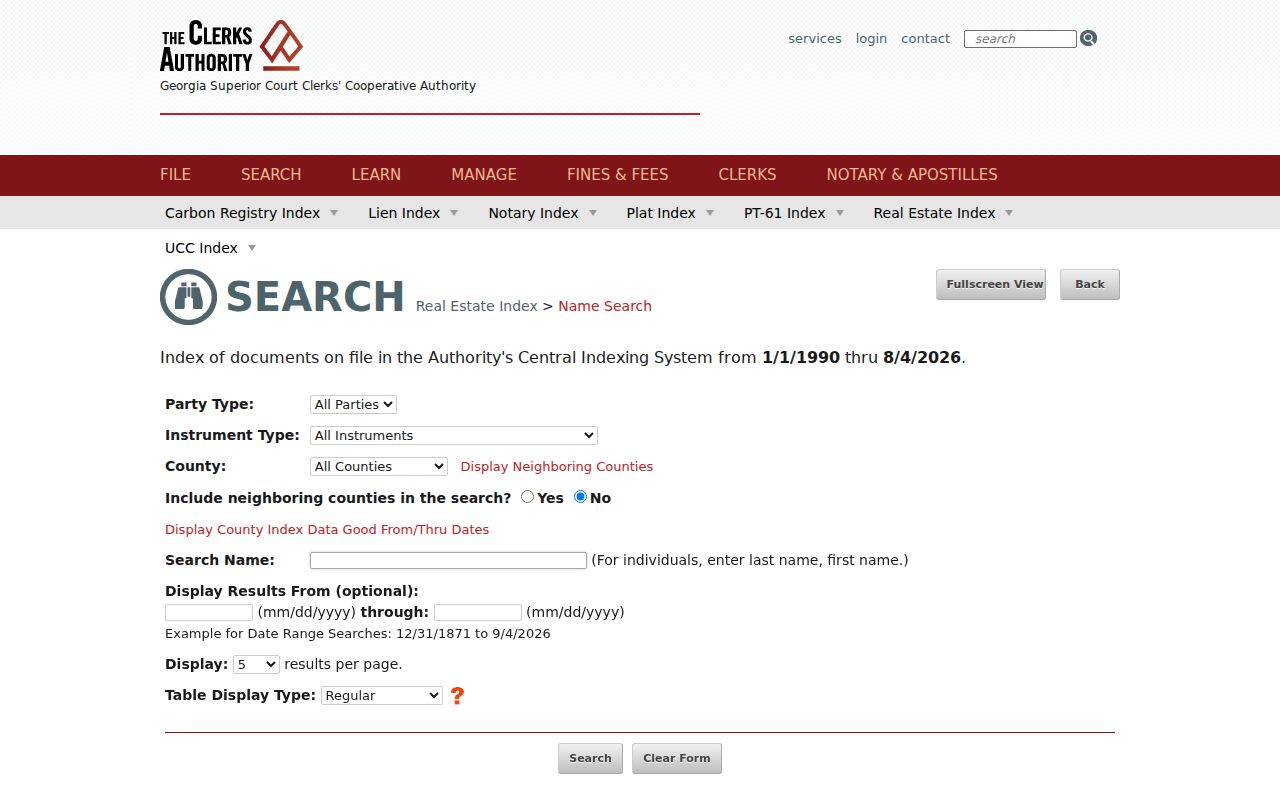
The official GSCCCA name-search screen is the starting point. Every Tattnall County deed result still has to be matched to the parcel and its recorded image.
- Locate the current parcel and copy the latest deed reference.
- Open or request the instrument and record the grantor exactly as indexed.
- Search that grantor as an earlier grantee, using name variants and a sensible date range.
- Match the legal description, not merely the street address.
- Repeat until the online trail ends, then take the last book/page citation to the clerk or archives.
- Grantor
- The party conveying an interest.
- Grantee
- The party receiving the interest.
- Reverse index
- An index organized from the grantee side, useful when walking ownership back.
- Chain of title
- The linked sequence of instruments affecting the same land.
- Quitclaim and warranty deed
- Different conveyance forms; neither label alone proves a clean title.
Read More Than Deeds in a Tattnall County Ownership History
Former owners often surface in odd instruments. The official GSCCCA guides list administrator and executor deeds, assents, foreclosure deeds under power, quitclaims, bargain-and-sale deeds, affidavits of death, powers of attorney, assignments, security deeds, modifications, and satisfactions. An estate or foreclosure can break a tidy buyer-to-seller pattern.
Security deeds and releases explain financing. They do not transfer ownership the way a deed does. A PT-61 can accompany an applicable transfer and may state a consideration figure. That figure is not an appraisal. Identify former owners only from the conveyance language on the recorded image. Keep the ownership chain separate from the encumbrance timeline.
Tattnall County's Earliest Online Ownership Year Is Not Confirmed
GSCCCA describes statewide real-estate index data reaching back to at least January 1, 1999. That date is a statewide floor. Tattnall County's own first online year stays unconfirmed. Do not treat it as a local promise. A no-result name may predate the window, carry a different spelling, or sit under a parent tract rather than the present address.
Coverage limit. Tattnall County's precise online cutoff is unconfirmed. Take the oldest verified citation to the Clerk's deed books or microfilm instead of assuming the chain ends online.
The Tattnall County Clerk of Superior Court maintains deeds, microfilm, indexes, plats, and other real-estate instruments. The office is open for public viewing. The county page lists no hours or copy fees. Call 912-557-6716 before traveling, and request a quote if certified copies or large-format plats are needed.
Old Jail Archives Extend Tattnall County Former-Owner Research
The Tattnall County Archives preserves original land grants, early plat books, historic court material, maps, newspapers, phone books, and yearbooks inside the Old Jail on Courthouse Square. Its oldest document dates to 1790. That predates the county itself, which was organized in 1801. Early-1800s land plat books were digitized. Still, no stable volume-by-volume online catalog exists.
This collection matters when a legal description points to an old plat, a family tract, a railroad, or adjoining landowners rather than a modern address. Ask staff for the record-group finding aid. Bring an approximate year, party name, book and page, and land description. Visiting hours are Friday, noon to 4 p.m. The published phone number is 912-557-6049.
Note: A historic map or directory supplies search clues, but only the linked deed, plat, or court instrument supports a land-history conclusion.
Rescued Tattnall County Records Explain Why Offline Searches Matter
Tattnall County's archival past is dramatic. Courthouse documents were reportedly rescued from an attic and even a dumpster. Survivors now rest in the Old Jail. That history carries a practical lesson, because a blank web result does not mean a record never existed, and local finding aids can surface volumes and name variants that no public portal carries. The archive also points to a local index of more than 40,000 names, though an older county description claimed above 25,000. Cite the wording and retrieval date too. Finding aids keep growing. Ask staff what has been indexed since an older guide appeared.
Plats Preserve Tattnall County Parent-Tract and Lot History
A split parcel can lose its old street wording. It may keep a plat name instead. The Real Estate Index guidance documents property and book/page search modes, so work each mode against the recorded plat for the deed you are chasing. Replats and later lot divisions explain why acreage shifts between transfers. Historic railroad names unlock older descriptions. Glennville and Collins sources preserve names like Wadley Southern, Seaboard Air Line, and Collins-Reidsville-Glennville. Search that exact old name in deeds and newspapers. Then check the legal description and the current parcel map before trusting the tract.
Former Owners May Lead Beyond Today's Tattnall County Line
Tattnall County was carved from Montgomery County in 1801. Toombs split away in 1905, and Candler and Evans followed in 1914. A long chain of owners can therefore cross into a parent or successor county. The land itself never moved. Follow the jurisdiction named at recording. Use the Georgia Archives for grants or county film. The Georgia Archives Virtual Vault county-film search covers the whole state, not just Tattnall parcels. Bring a county name, record type, volume citation, date range, and party name. That packet can reconnect prior owners across an old county line. It works far better than a modern address.
Use Tattnall County Former-Owner Records With Care
A reconstructed chain can serve many purposes. House history, estate research, boundary review, and purchase diligence all benefit. It is not a title opinion, though. Index errors, unrecorded interests, probate events, name changes, and parcel splits leave gaps that may demand reading the instrument itself or professional title work.
Lawful use. Former-owner research is appropriate for property history and due diligence. Public names and addresses must never be used to stalk, threaten, or harass anyone.
Note the source and date for each link. Save the URL or office, spelling, and book/page too. When certainty matters, obtain recorded images or certified copies from the custodian and have a qualified professional review the legal effect.