
Identify Who Owns a Tattnall County Property
Ownership searches in Tattnall County go smoother when you chase the parcel, not the person. The Tax Assessor's qPublic record gives an owner-of-record name plus useful parcel details. The Clerk of Superior Court's deed index then shows the recorded conveyance behind that name. Each system answers a different question. A solid result traces one address and one legal description through both, so the assessor entry and the deed support the same conclusion rather than competing with it.
- Accept the disclaimer at the Tattnall qPublic search and locate the situs address.
- Copy the owner name, parcel/APN, mailing address, legal description, and deed reference or last-sale details.
- Search that owner as grantee in the GSCCCA Real Estate Index, limited to Tattnall County.
- Compare the newest deed’s grantee and legal description with the tax parcel; open the image if the account tier permits.
- If an LLC, estate, or trust holds title, preserve that exact name and use entity or probate records only as a cross-reference.
Start With Tattnall qPublic, Then Check the Deed
The assessor portal is where discovery starts. It supports searches by owner, address, and parcel, though the live Tattnall field labels vary. Its static pages carry a useful caution. Values reflect the latest published digest. Ownership and map data may still be in process, and courthouse deeds should be checked for current ownership. That warning matters most right after a closing. The roll has not caught up to the newest deed then.
The recorder layer is the GSCCCA Real Estate Index. Official guidance describes searching by grantor and grantee name, county, date range, instrument type, book and page, and, where enabled, subdivision details. Results can list parties, location, and book/page, while image access depends on the account tier. The deed itself carries the language. That language has to match the parcel, not the index label.
The official assessor landing page gives the county context for this first ownership check.
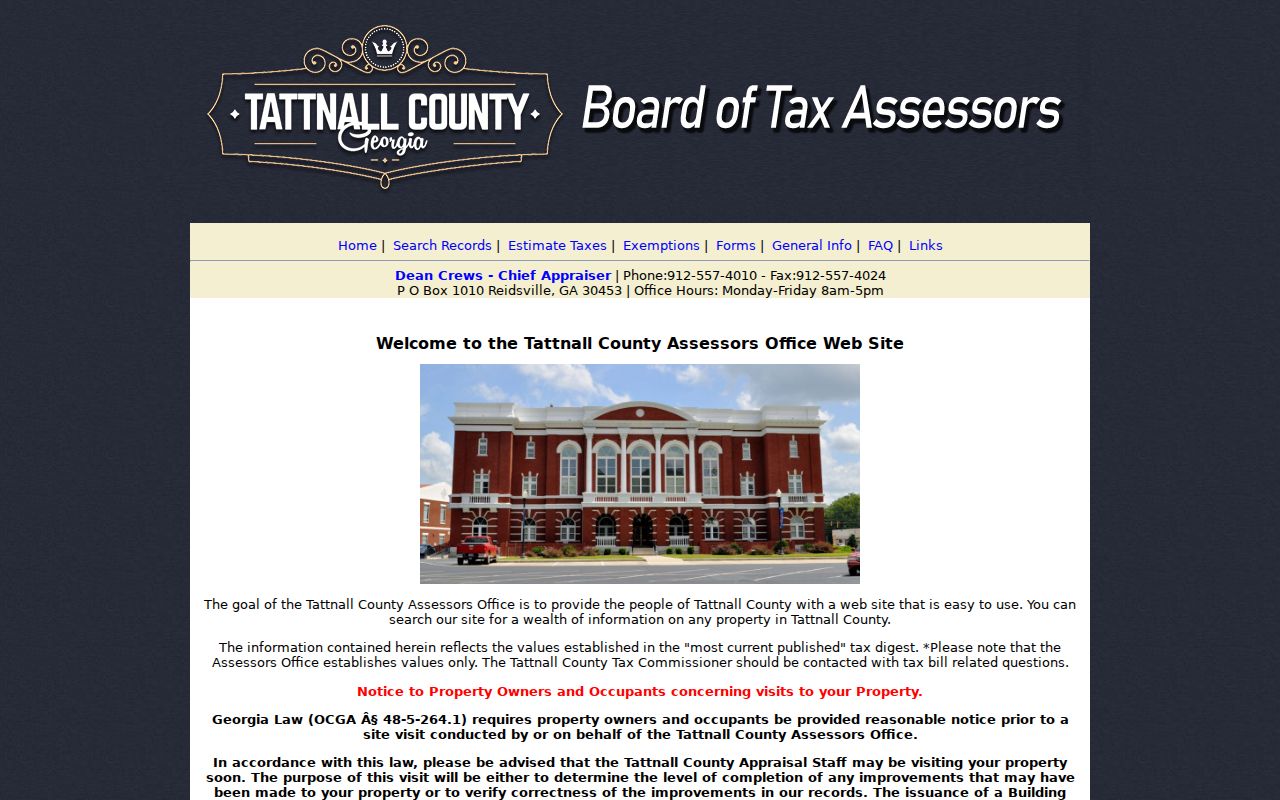
The qPublic page confirms the official route and the assessment purpose behind it. It cannot substitute for picking the parcel and reading the latest recorded conveyance.
Resolve Owner Names, Estates, Trusts, and Companies
Names hide ownership in plain sight. Search people last-name-first, with initials, without middle names, and with suffix variants. For an estate, try both the decedent and the executor or administrator. A trust may appear under the trust name or the trustee. Companies need their exact punctuation and legal suffixes. The Georgia eCorp Business Search confirms the exact name, control number, registered agent, or officer record.
An eCorp match explains a company name but does not prove it owns land. A registered agent accepts legal service and is rarely the beneficial owner. The newest deed naming the company as grantee is the real property-record check. When several people share a name, compare APN, situs, legal description, deed date, and mailing address. Continue until only one record fits.
Note: Keep an entity cross-reference separate from the recorded grantee; the two records answer different questions.
Compare Tattnall County Ownership Sources
No single screen answers every "who owns" question in Tattnall County. Match the source to the stage of your search, and write down its date.
| Official source | Ownership clue | Currency and access |
|---|---|---|
| Tax Assessor qPublic | Processed roll owner, mailing and situs addresses, APN, values, legal-description clues | County-linked public gateway; data can lag processing |
| Clerk / GSCCCA | Grantee, instrument, recording date, and book/page on the latest conveyance | Index and account-dependent image access; office viewing available |
| Parcel map | Spatial link between an address and APN | Reference map, not ownership certification or survey |
| Georgia eCorp | Exact entity name, registered agent, and officer record | Free cross-reference; not proof of title |
The roll owner can differ from an occupant. The roll owner can also differ from a tax-mail recipient. And the roll owner can differ from a contract purchaser or a recent grantee. "Owner of record" always needs a source and a date attached. For present-owner detail, use the current owner guide. For earlier owners, follow the separate deed chain. Do not stretch this method into a historical search.
Keep Situs, Mailing, and Municipal Geography Straight
A situs address names the physical property. A mailing address just tells you where notices go. That address can sit outside Georgia, and it never proves the owner lives there. Postal-city wording also fails to settle whether a parcel lies inside Reidsville, Glennville, Collins, Cobbtown, or Manassas. ZIP coverage and city boundaries are two different systems.
If zoning, permits, or city jurisdiction drive the question, keep the APN and legal description and compare official planning or municipal-boundary records. A modern road name may also differ from a historic rural route, railroad, business, or highway description. Use those variants to find the record first. Then normalize the match through the deed description.
Use the Tattnall Clerk Counter as the Offline Fallback
The Clerk of Superior Court is Tattnall's recorder route under Georgia law. The office keeps deeds, plats, liens, and real-estate instruments. It also holds indexes and microfilm. The office states that most real-estate records are open for public viewing. Paige D. Mulligan's office is listed at PO Box 39, Reidsville, telephone 912-557-6716. Counter hours and copy fees are not published, so verify both before a visit.
GSCCCA describes statewide index coverage reaching back to at least January 1, 1999. The earliest Tattnall-specific year is harder to pin down. When an online result or image is missing, bring the party name, an approximate date, and the APN. Also bring the legal description and any book/page reference. Ask for the existing instrument rather than asking staff to decide ownership or give legal advice.
Before traveling, call 912-557-6716 to confirm hours and the local copy schedule. Ask which search key will work best. Pack the parcel number, every owner-name spelling, and an estimated transfer window. Add any book and page found on qPublic. Ask whether a public terminal reaches material the general GSCCCA landing page does not show. Ask the same about any physical index. If the current name belongs to an estate or an entity, include the exact suffix. Then request instruments from both the buyer and seller side of the index.
Watch for Deed-Copy and Owner-Lookup Scams
Watch for deed-copy solicitations. Some letters offer a deed copy at a steep price. Others claim urgent payment is needed to protect title. Before paying anything, confirm the book and page with the clerk. Ask about the current copy charge. Tattnall County publishes no property-fraud-alert signup. So treat any monitoring pitch as a private offer rather than something the county stands behind.
Commercial people-search sites work poorly for this task. They blend people with similar names. They hold onto stale addresses. They also leave out parcel-specific legal details the deed records contain. Official records can still contain errors. Yet they name the custodian and show the record date. They offer a correction path, which is what you need to answer who owns a particular parcel.
Know the Limits of a Tattnall Owner Lookup
A public record has real limits. It can name the party on a Tattnall County tax roll or deed, but it cannot guarantee title, prove occupancy, interpret an easement, or untangle every heir or trust interest. A recorded deed may also be followed by another instrument, a court order, a probate transfer, or an unprocessed tax update. For a purchase or contested title, rely on the official instruments and qualified professional review.
Georgia's Open Records Act opens the door to existing records. It still allows exemptions and redactions. VoteSafe adds separate protection for qualifying voters facing safety risks, so never reconstruct a shielded address or merge parcel data with unrelated personal sources.
Lawful use. Use a Tattnall County owner lookup for legitimate property research, boundary questions, estate work, or purchase diligence,never to stalk, harass, intimidate, or harm anyone.